
The winning aerospace project puts an electric spin on urban air mobility.

Team Fan Fan Club Left to right: Aidan Bedwell, Rivaldy Gaghana, Jarrett Latty, McCay Turner, Andrew Wood, Sonia Thakur, Sofia Arner, Emma Joly, and AE Chair Mitchell Walker.
MARMOSET, a fully electric version of the XV-15 tiltrotor aircraft, won the Best Aerospace Engineering Project at the Fall 2025 Capstone Expo, held at McCamish Pavillion. The vehicle was inspired by a mission from the Vertical Flight Society (VFS) Design Competition to make the XV-15 —an experimental tiltrotor developed by NASA and Bell that combines the vertical takeoff and landing capabilities of a helicopter with the forward flight of an airplane—hybrid.
Team Fan Fan chose to design and build a fully electric aircraft at one-twentieth scale and go the extra mile and optimize the vehicle for urban air mobility purposes with the objective to maximize internal payload capacity, minimize power consumption, maximize the range of travel for the aircraft and to minimize noise.
“We saw a problem in the world and aimed to solve it. We were interested in tackling the complications of urban air mobility and saw a gap in the market. We believe the XV-15 was uniquely suited to address the mission as it relates to hurdles associated with flying people in an urban area with limited space. Some startups are now focused on a smaller operational range or the distance an aircraft can travel on a single fuel load or battery charge. The XV-15, because it has a tiltrotor, and has significantly more benefits for forward flight and for fast flight served as a great starting point,” said Emma Joly, AE undergraduate student and co-team lead.
The ten-member team focused on design for manufacturability, ensuring all parts of the 3D-printed model could be produced without excessive supports. They also gained firsthand experience of tuning Proportional, Integral, and Derivative (PID) controllers—a process they learn in theory in class. PID controllers are control systems used in engineering to regulate things like speed, position, or stability in mechanical and electrical systems. Adjusting these control parameters for the physical model taught them a lot about achieving stable flight and refining the control system.
Team members include: Aidan Bedwell, Andrew Wood, Daleiah Moniz, Emma Joly, Jarrett Latty, McCay Turner, Rivaldy Gaghana, Ruhit Biswas, Sofia Arner, and Sonia Thakur.
“I'm very proud of my AE 4332 team. When we started this semester, they expressed interest in not only completing the conceptual design of a 5-passenger, fully electric tiltrotor for initial use as an urban air mobility transport from Sandy Springs to Hartsfield-Jackson Atlanta International Airport, but they also wanted to challenge themselves to build a 1/20th scale model and flight test it. They succeeded, demonstrating the aircraft in hover in the GT-AE Indoor Flight Lab. Well done!” said Professor Chance McColl, team advisor.

Their prototype, named MARMOSET, stands for Metro Atlanta Rapid Mobility Service Electric Tiltrotor, reflecting both their regional ties and commitment to sustainable urban air mobility.

Beyond their technical ambition, the team’s name celebrates their love for rotorcraft. In aviation, rotors are often called “fans,” and these students proudly embrace that identity—Fan Fan Club.
“The urban air mobility field is growing rapidly, so addressing this challenge in rotorcraft design is critical. The project gave us valuable insights into battery technology, renewable energy, and why certain designs dominate the field,” said Aidan Bedwell, AE undergraduate student and co-team lead.

Team Fan Fan Club Poster for the 2025 Fall Capstone Expo
Team Fan Fan Club divided responsibilities to ensure success. Bedwell led fabrication of the model, while Joly spearheaded the flight control system thanks to her software ability. Other members focused on simulation, testing, power systems, flight dynamics, and structural analysis. Their efforts included a comprehensive study of the theoretical full-scale design and the creation of the prototype to validate performance.
“The team’s effort encapsulated the objectives of our Capstone Design courses: challenge yourself and your teammates to go above and beyond even your own expectations,” McCall said.
Reflecting on the achievement, the team emphasized how their approach addressed problems in urban air mobility. “We were able to confront the close-range limitations many startups face, and we designed a vehicle capable of longer missions and city hopping,” Joly explained. “We believe this flexibility represents the future of urban air mobility.”
“In earlier senior design classes, many aircraft, spacecraft, and rotorcraft teams were never pushed to build a physical model—some didn’t even realize it was an option. My advice is to reach out early and advocate for what you want to do instead of simply following instructions. Go the extra mile and pursue the aspects of the project that excite you,” Bedwell said.
Related Stories:
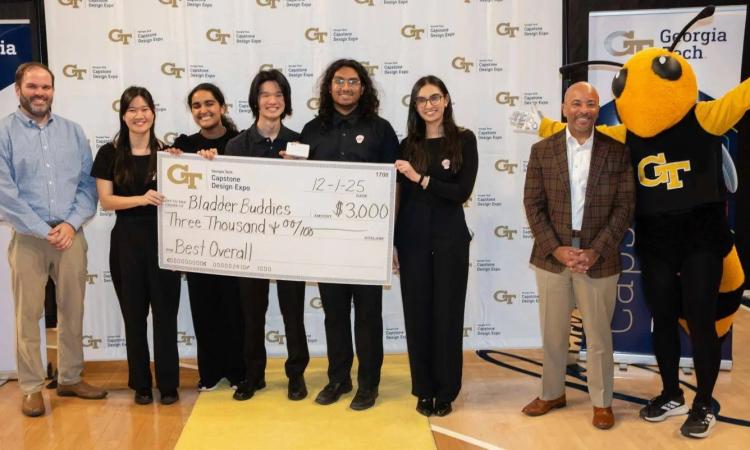
Self-Assembled Eyeglasses, Wearable Device for Bladder Health Win Capstone Expo
The fall 2025 showcase included semester-long design projects from more than 600 students across engineering, design, and computing.
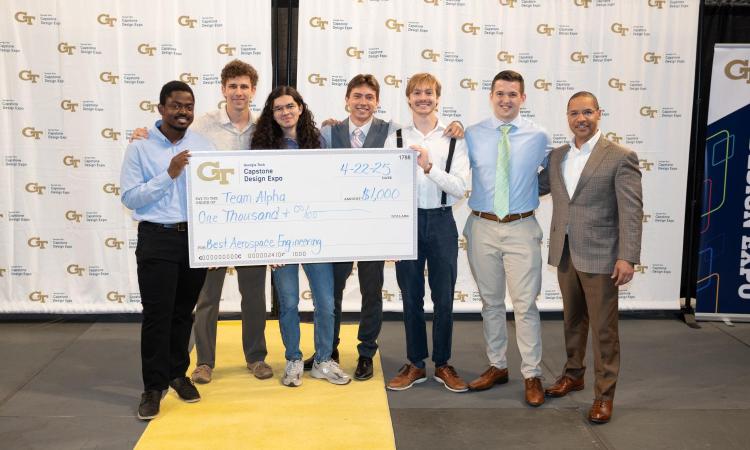
Team Alpha Captures Top Aerospace Engineering Prize at Capstone Design Expo
Team Alpha was selected as the Best Aerospace Engineering project at the Spring 2025 Capstone Design Expo for their homeland defense interceptor (HDI) vehicle design, MQ-25 Horsefly. This year, 20 School of Aerospace Engineering teams vied to take home the AE award, while 238 teams from 12 schools competed for Overall Best Project.