
AE Seminar
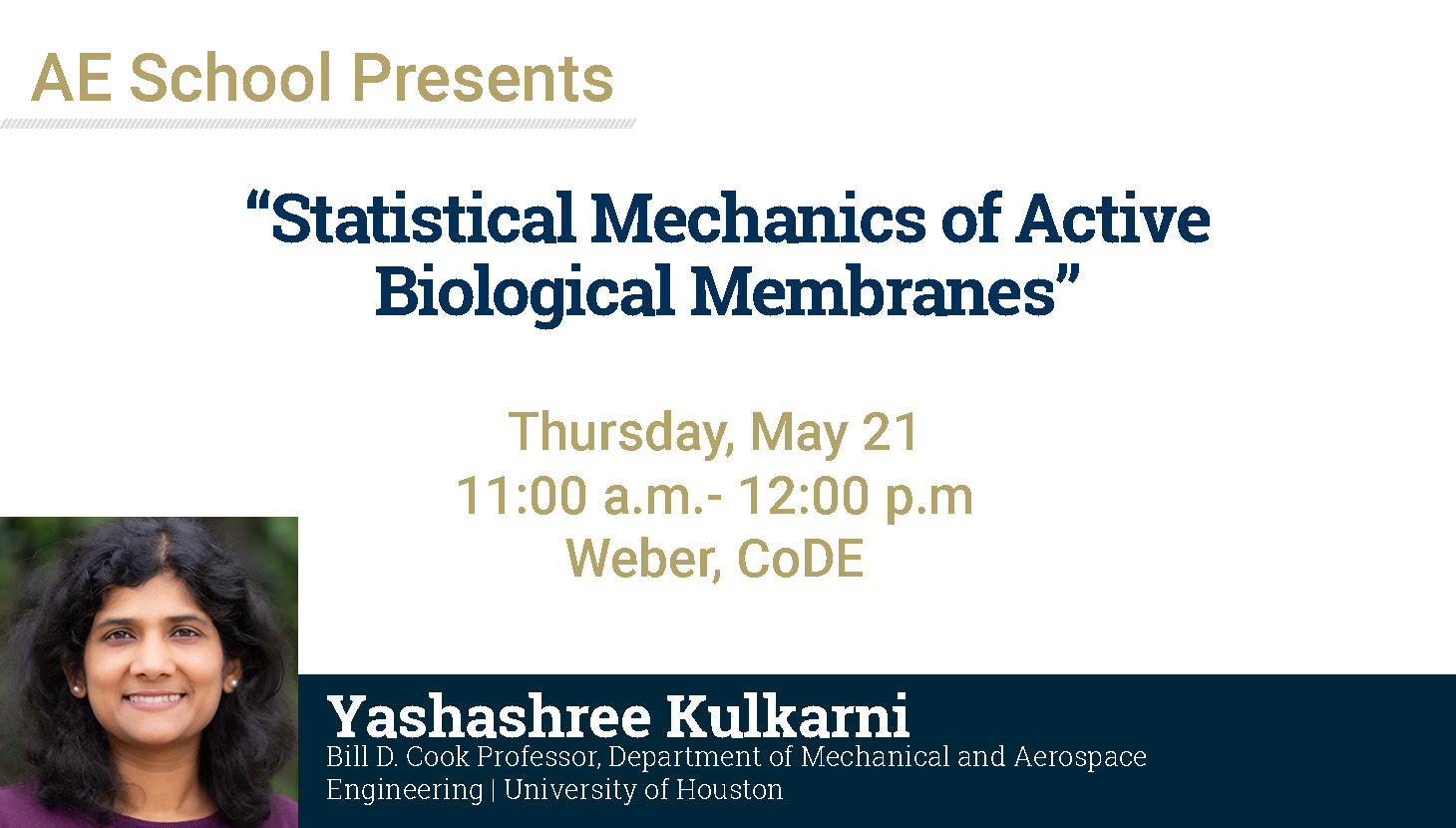
“Statistical Mechanics of Active Biological Membranes”
featuring
Yashashree Kulkarni
Bill D. Cook Professor, Department of Mechanical and Aerospace
Engineering University of Houston
Thursday, May 21
11:00 a.m.- 12:00 p.m.
Weber, CoDE
About the Seminar:
Biological membranes, such as cell membranes that separate cells from their environment, play a vital role in critical physiological processes like endocytosis, cell division, and cell motility. Statistical mechanics and continuum mechanics are powerful theoretical tools that have provided phenomenal insights into the mechanics of these biological membranes and crystalline interfaces over decades. However, most studies, until recently, have focused entirely on passive (or ‘‘dead’’) membranes that exhibit only equilibrium thermal fluctuations. In contrast, active membranes are ‘‘alive’’ with their own energy source capable of circumventing equilibrium considerations and exhibit fluctuations that are non-thermal in origin. In this talk, we will present a non-equilibrium statistical mechanics-based model for active biological membranes and explore its application in addressing critical questions in biophysics. First, we will investigate the role of activity in determining the size distribution of vesicles which are the primary modes of communication and transport in cell biology. Second, we will demonstrate how active matter plays a key role in the extraordinary sensitivity of biological membranes to electric fields. These studies can open avenues for a deeper understanding of the mechanics of physiological and pathological processes.
About the Speaker:
Biological membranes, such as cell membranes that separate cells from their environment, play a vital role in critical physiological processes like endocytosis, cell division, and cell motility. Statistical mechanics and continuum mechanics are powerful theoretical tools that have provided phenomenal insights into the mechanics of these biological membranes and crystalline interfaces over decades. However, most studies, until recently, have focused entirely on passive (or ‘‘dead’’) membranes that exhibit only equilibrium thermal fluctuations. In contrast, active membranes are ‘‘alive’’ with their own energy source capable of circumventing equilibrium considerations and exhibit fluctuations that are non-thermal in origin. In this talk, we will present a non-equilibrium statistical mechanics-based model for active biological membranes and explore its application in addressing critical questions in biophysics. First, we will investigate the role of activity in determining the size distribution of vesicles which are the primary modes of communication and transport in cell biology. Second, we will demonstrate how active matter plays a key role in the extraordinary sensitivity of biological membranes to electric fields. These studies can open avenues for a deeper understanding of the mechanics of physiological and pathological processes.