
AE Seminar
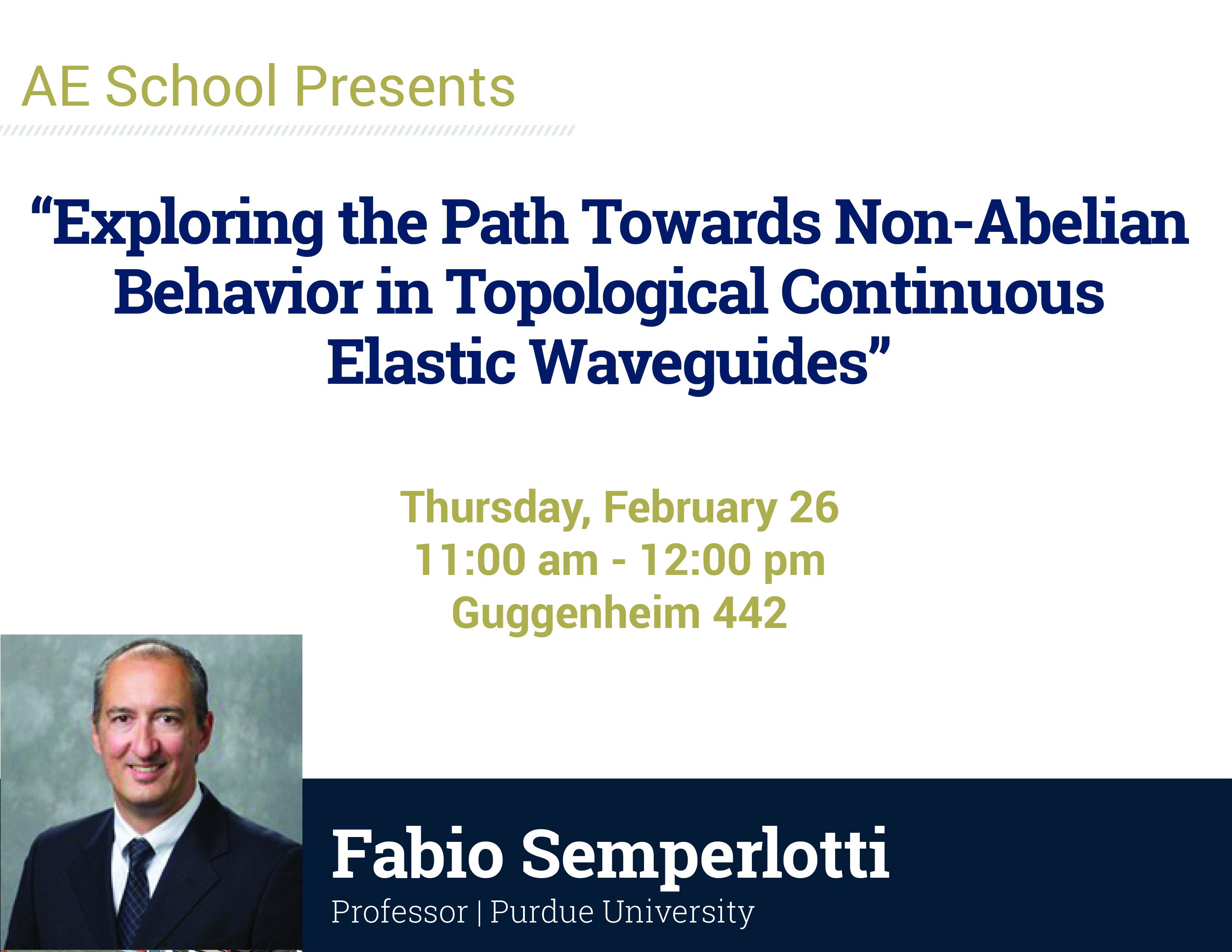
“Exploring the Path Towards Non-Abelian Behavior in Topological Continuous Elastic Waveguides”
featuring
Fabio Semperlotti
Ray W. Herrick Laboratories, School of Mechanical Engineering, Purdue University
Thursday, February 26
11am - 12pm
Guggenheim 442
About the Seminar:
Inspired by recent discoveries of topological phases of matter in quantum physics, there has been a rapidly growing research effort to uncover analog mechanisms in classical wave physics, including acoustics and elastodynamics. By acting on key material symmetries, classical elastic materials can deliver dispersion and propagation properties reminiscent of selected topological quantum mechanical systems. Yet, of the ten topological classes, only a few have been successfully translated into their classical mechanical counterpart. In particular, the classes capable of non-abelian (i.e. order-dependent) behavior have attracted significant interest but their realization has proven quite elusive. In actual quantum systems, achieving non-abelian behavior can profoundly impact applications and it is currently regarded as one of the most promising ways to achieve robust qubits and noise-tolerant quantum computation. In elastic systems, non-abelian behavior can lead to the design of mechanical analog quantum gates, therefore opening exciting opportunities to pursue on-material analog computations and signal processing.
This talk will examine the requirements and potential strategies to realize non-abelian behavior in continuous elastic waveguides. As the topological behavior of materials strongly depends on the ability to control the accumulation of geometric phase, the discussion will begin with strategies to manipulate the geometric phase in continuous elastic waveguides by means of geometry manipulation. Then, two possible pathways to pursue non-abelian behavior in physically realizable continuous structures will be presented. The first explores the necessary building blocks to achieve class-D systems by embedding quasi-1D concepts, like the discrete Su-Schrieffer-Heeger (SSH) ladder, into 2D elastic waveguides. The second leverages an equivalent Thouless pumping method to produce continuous waveguides capable of non-abelian mode braiding. The performance of both strategies will be illustrated via a combination of theoretical, numerical, or experimental results.
About the Speaker:
Dr. Fabio Semperlotti is a Professor in the School of Mechanical Engineering and the Perry Academic Excellence Scholar at Purdue University; he also holds a courtesy appointment in the School of Aeronautics and Astronautics Engineering. He directs the Structural Health Monitoring and Dynamics laboratory (SHMD) where he conducts, together with his group, research on several aspects of structures and materials design including structural dynamics and wave propagation, elastic metamaterials, structural health monitoring, and computational and experimental mechanics. His research has received financial support from a variety of sources including the National Science Foundation, the Department of Defense, the Department of Energy, and industrial sponsors. Dr. Semperlotti was the recipient of the National Science Foundation CAREER award (2015), the Air Force Office of Scientific Research Young Investigator Program (YIP) (2015), the DARPA Young Faculty Award (YFA) 2019, and the ASME C.D. Mote Jr. Early Career Award 2019.
Dr. Semperlotti received a M.S. in Aerospace Engineering, and a M.S. in Astronautic Engineering both from the University of Rome “La Sapienza” (Italy), and a Ph.D. in Aerospace engineering from the Pennsylvania State University (USA). In 2010, he was a postdoctoral research associate in the Mechanical Engineering department at the University of Michigan. Prior to joining Penn State, Dr. Semperlotti served as a structural engineer for a few European aerospace industries, including the French Space Agency (CNES), working on the structural design of space launch systems and satellite platforms.