
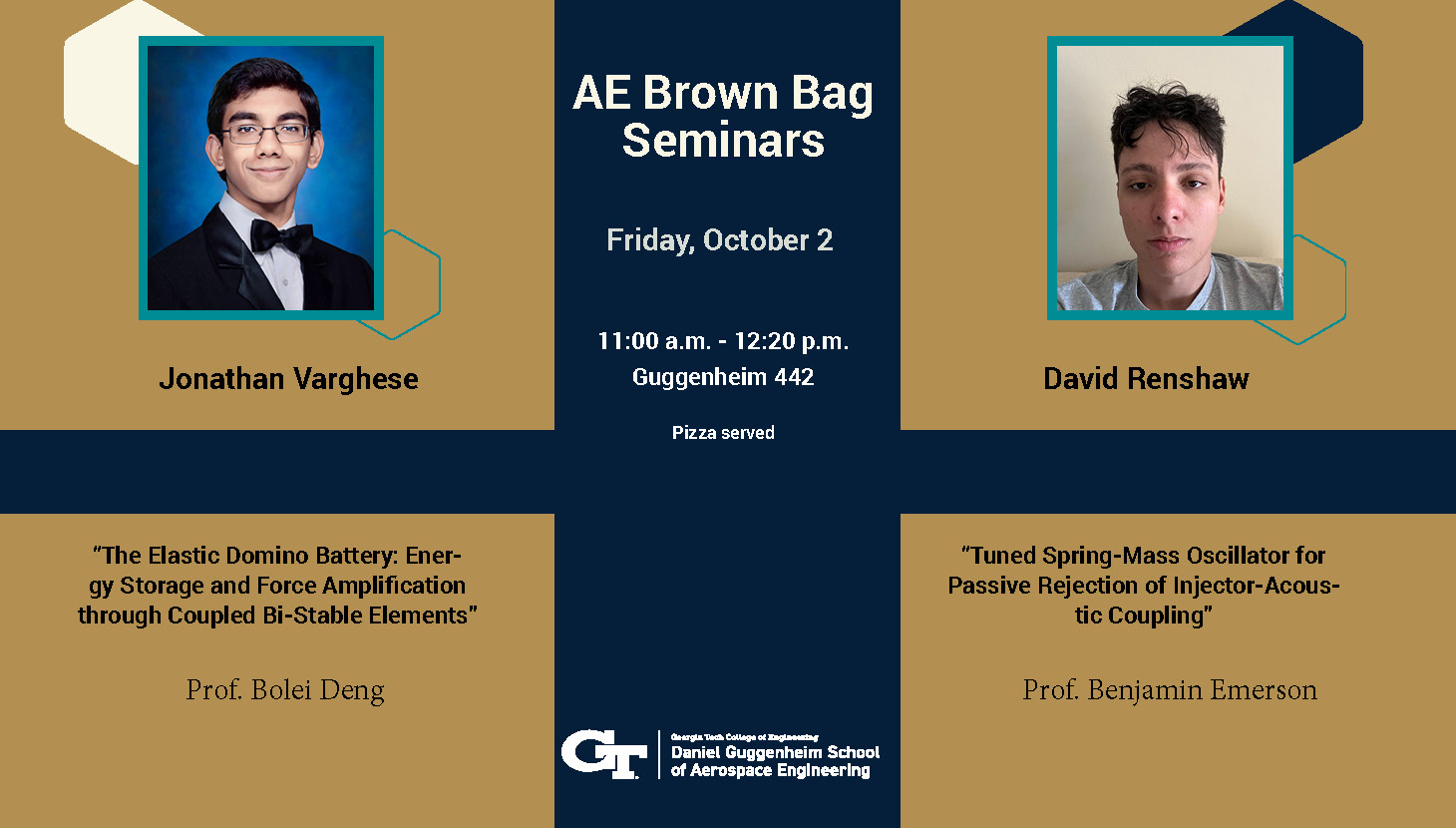
AE Brown Bag Seminar
featuring
Jonathan Jimmy Varghese
David Renshaw
Friday, October 2
11:00 a.m. - 12:20 p.m.
Guggenheim 442
Pizza served
David Renshaw
Title:
Tuned Spring-Mass Oscillator for Passive Rejection of Injector-Acoustic Coupling
Abstract:
Combustion systems can be susceptible to thermoacoustic instabilities in which pressure oscillations couple with injector mass-flow fluctuations and unsteady heat release. Conventional injector design mitigates this interaction by maintaining a relatively large pressure drop across the injector, otherwise known as injector stiffness. This project investigates an alternative approach without the cost of pressure loss; the injector geometry itself responds passively to pressure fluctuations using a metallic element that behaves as a tuned spring-mass system. As the pressure differential across the injector fluctuates, the compliant element deflects and changes the effective flow area in a direction intended to counteract the pressure-driven variation in mass flow. The analytical model combines quasi-steady orifice flow relations with spring-mass-damper dynamics to determine the stiffness, displacement, effective pressure area, damping, and natural-frequency requirements needed for cancellation, while also accounting for additional fluid motion produced by the forcing plate. The resulting frequency-domain model is used to evaluate how effectively the injector can attenuate mass-flow fluctuations relative to a rigid injector.
Faculty Advisor:
Professor Benjamin Emerson
Jonathan Varghese
Title:
The Elastic Domino Battery: Energy Storage and Force Amplification through Coupled Bi-Stable Elements
Abstract:
Conventional energy storage relies on chemical batteries and electronics, which face severe vulnerabilities in extreme conditions such as ionizing radiation, corrosion, and extreme pressures. Embedding storage directly into a physical structure provides a robust alternative: by deliberately engineering mechanical instabilities, bi-stable components with asymmetric energy landscapes can act as mechanical batteries, managing energy through intrinsic dynamics. However, a critical tradeoff exists. In isolated bi-stable elements, maximizing stored energy inherently increases sensitivity to involuntary triggering. To overcome this limit, we introduce a system leveraging mechanical cascading reactions - a "domino effect" if you will - in which smaller elements use their excess energy to sequentially trigger larger ones, enabling substantial force amplification. We develop a force-landscape model of the individual bi-stable element and extend it to a coupled chain linked by unilateral, contact-only springs, then compare two sizing strategies for reaching a target force amplification: a naive approach using a constant amplification ratio at every stage, and an optimized approach that distributes the ratio unevenly across the chain. Framing reliability as a confusion matrix over intended and accidental triggering, we show that for the same total amplification and stored energy, the optimized design is substantially more resistant to accidental (false-positive) triggering under external load, converging toward a theoretical best-possible trade-off as the chain grows longer.
Faculty Advisor:
Professor Bolei Deng